Vantrue: Multi-Channel Dash Cams
Vantrue builds premium dash cams with multi-channel recording, Sony STARVIS 2 sensors, and 24/7 parking protection for drivers who want serious coverage.

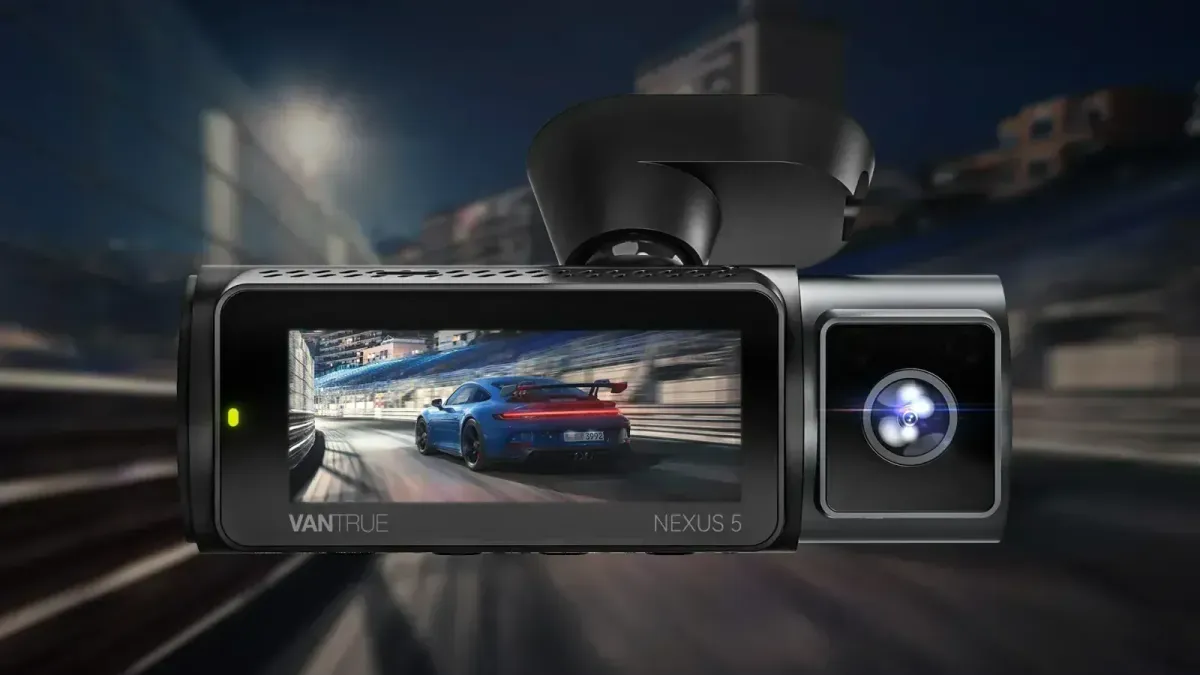
Vantrue has carved out a clear position in the crowded dash cam market by focusing on sensor quality and channel count rather than chasing the lowest price point. The brand's catalog spans single-channel front cameras all the way up to four-channel systems and 360-degree panoramic units, with Sony STARVIS 2 image sensors appearing across the lineup as a recurring commitment to low-light performance. Drivers who want more than a basic "something happened" recording and instead want clear, usable footage at night, in parking lots, and from multiple angles at once are the audience Vantrue is building for.
Vantrue at a Glance
What We Liked
- Sony STARVIS 2 sensors appear across multiple models for strong low-light and night performance
- Multi-channel options (up to four cameras) provide coverage most competitors don't offer at this tier
- PlatePix™ technology sharpens license plate capture beyond standard 4K resolution
- 5GHz Wi-Fi and optional LTE connectivity on flagship models for remote monitoring
What Could Be Better
- 24/7 parking mode requires a hardwire kit sold separately on several models
- Four-channel and 360-degree builds add installation complexity that may require professional help
How Vantrue Builds Around the Sensor-First Philosophy
Most dash cam brands lead with resolution numbers. Vantrue does too, but the more interesting story is what sits behind those numbers. The brand uses Sony STARVIS 2 CMOS sensors across its Nexus and Sonnet lines, a sensor family that was originally developed for surveillance applications where low-light clarity is non-negotiable. That origin matters because a dash cam that looks great in daylight but turns headlights into smeared blobs at night is only doing half its job.
Vantrue pairs those sensors with its own PlatePix™ technology, a processing layer the brand claims makes license plate capture 1.5x sharper than competing systems at equivalent resolution. For anyone who has ever filed an insurance claim with footage that clearly shows a car but not its plate, that claim is worth taking seriously. The rest of the feature set, including HDR processing, buffered pre-recording, and voice control, follows a similar pattern: each addition addresses a specific failure mode of cheaper cameras rather than adding features for the sake of a spec sheet.
Nexus 5
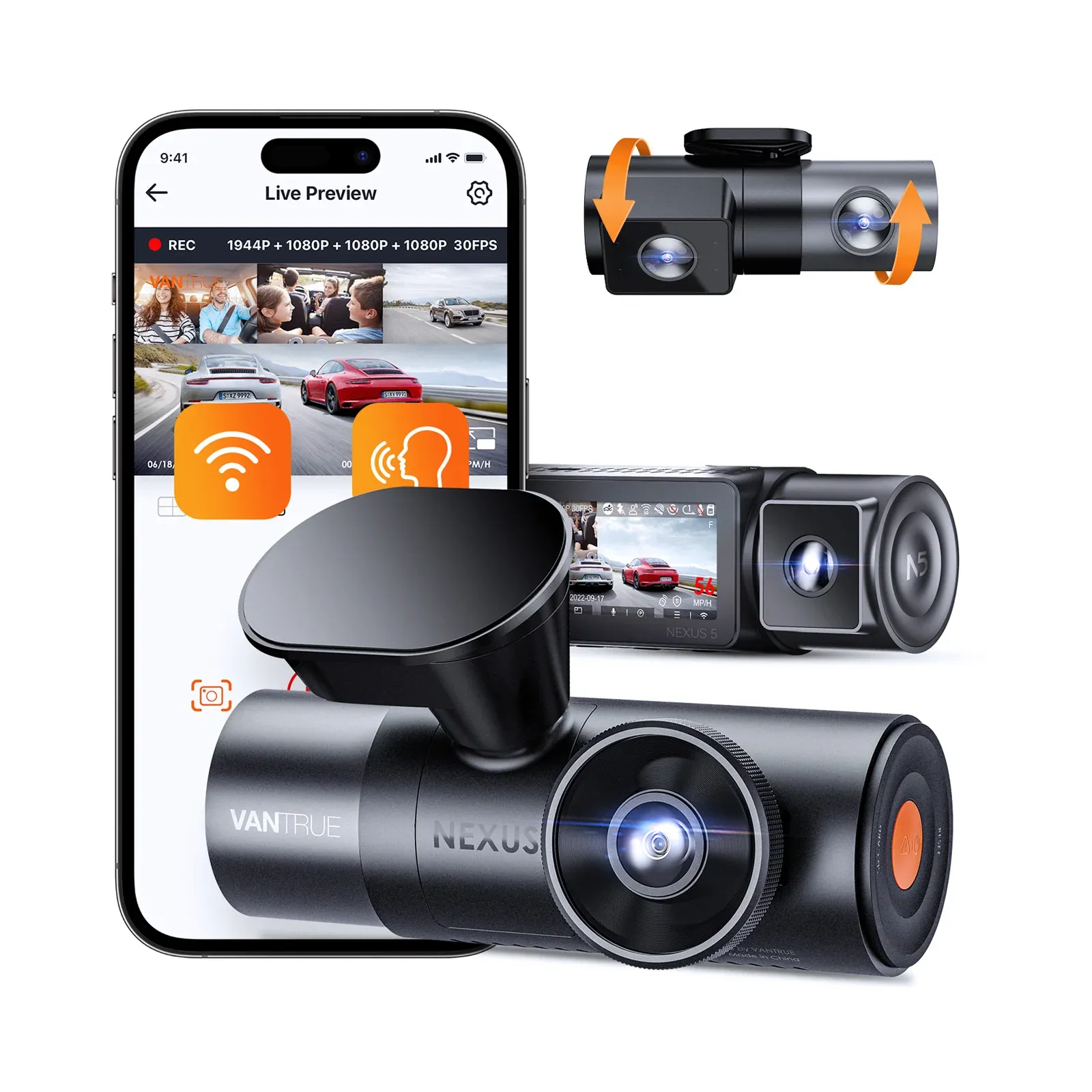
The Nexus 5 is Vantrue's answer to the question of how many angles a single dash cam system can realistically cover. It records across four channels simultaneously: front, front cabin, rear cabin, and rear. The front camera captures at 1944P while each of the remaining three channels records at 1080P, giving you a 2.5K-quality primary view and full HD coverage everywhere else. For rideshare drivers, fleet operators, or anyone who regularly carries passengers and wants documentation of what happens inside the car as well as outside, this is one of the few consumer-grade systems that handles all of it in one unit.
The Nexus 5 connects via 4-way WiFi and includes built-in GPS, so route data is embedded in the footage alongside the video. Infrared night vision covers the cabin channels, which matters when the interior is dark and a standard camera would capture nothing useful. Voice control is included, a practical addition when you need to lock a clip or take a photo without reaching for a phone or the camera itself.
The honest tradeoff here is complexity. Four channels mean four camera positions to mount, route cables for, and keep in frame. This is not a Sunday-afternoon install for most people, and the 24-hour parking mode that makes the system genuinely useful as a security tool requires a hardwire kit that is sold separately. If you only need front and rear coverage, the Nexus 5 is more camera than you need. But for the buyer who wants the most complete picture of everything happening around and inside their vehicle, it covers ground that two-channel systems simply cannot.
E360
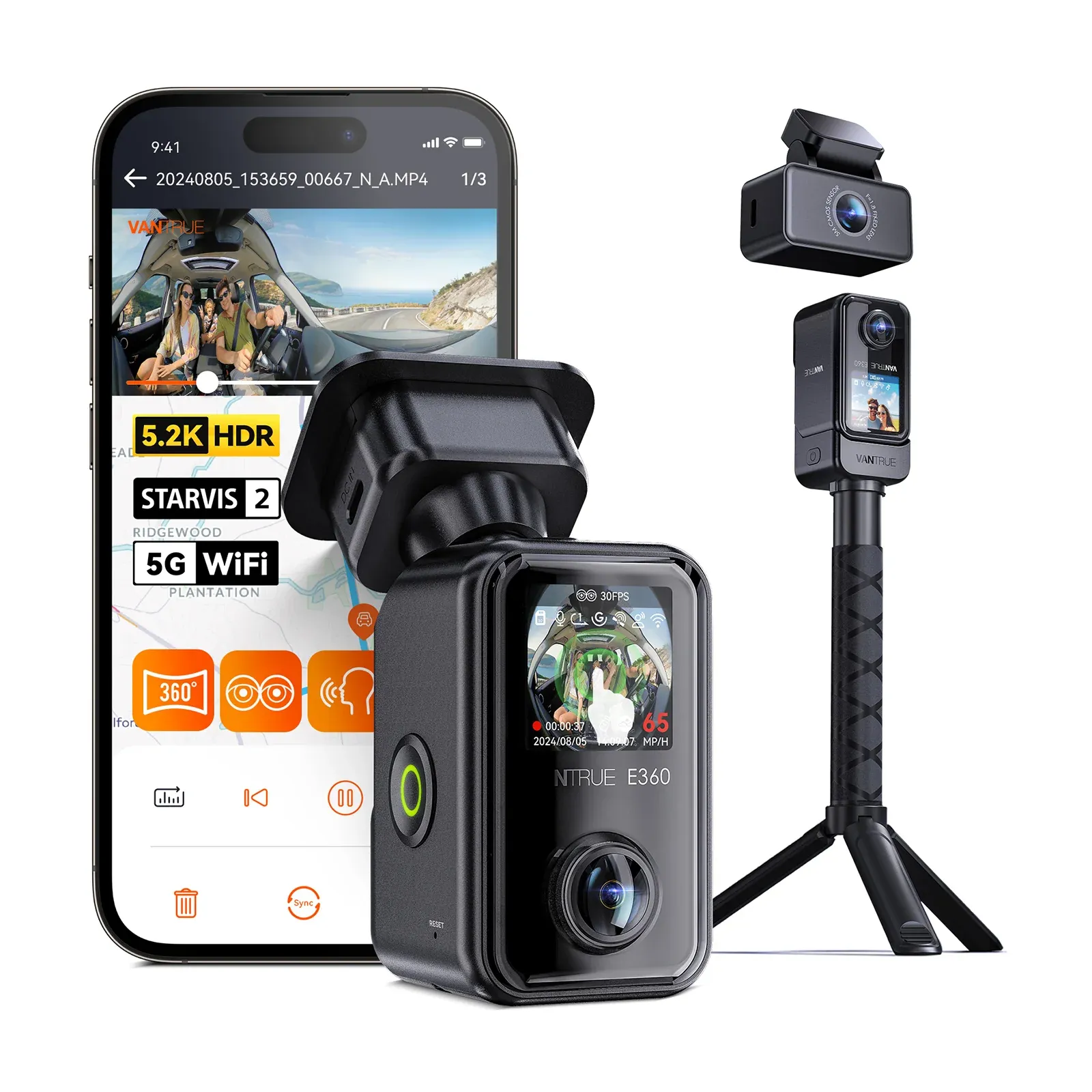
The E360 takes a fundamentally different approach to full-vehicle coverage. Rather than mounting separate cameras at the front, rear, and interior, it uses dual fisheye lenses with a 210° + 210° field of view and stitches those feeds together into a single 5.2K 360-degree panoramic image. The result is one unit, one mounting point, and coverage of the entire cabin and immediate surroundings without routing cables to a rear window.
Vantrue also offers the E360 ACE variant (per the product page), and the system includes an optional 2.7K rear camera with a 165° wide-angle view for drivers who want dedicated exterior rear coverage in addition to the panoramic view. Eight infrared LED lights handle night vision, and the 15-second pre-recording buffered motion detection means the system captures what happened before an incident, not just after. A four-hour built-in battery and 5GHz WiFi round out a feature set that is clearly aimed at drivers who want simplified installation without sacrificing coverage.
The fisheye-and-stitch approach does involve a processing step that traditional multi-camera setups avoid, and some drivers prefer the unprocessed clarity of a dedicated rear camera over a stitched panoramic view. The included 2.7K rear camera option addresses that preference directly. The E360 makes the most sense for drivers who want comprehensive coverage with minimal cable runs, particularly in vehicles where routing a rear camera cable is difficult.
Nexus 4 Pro S
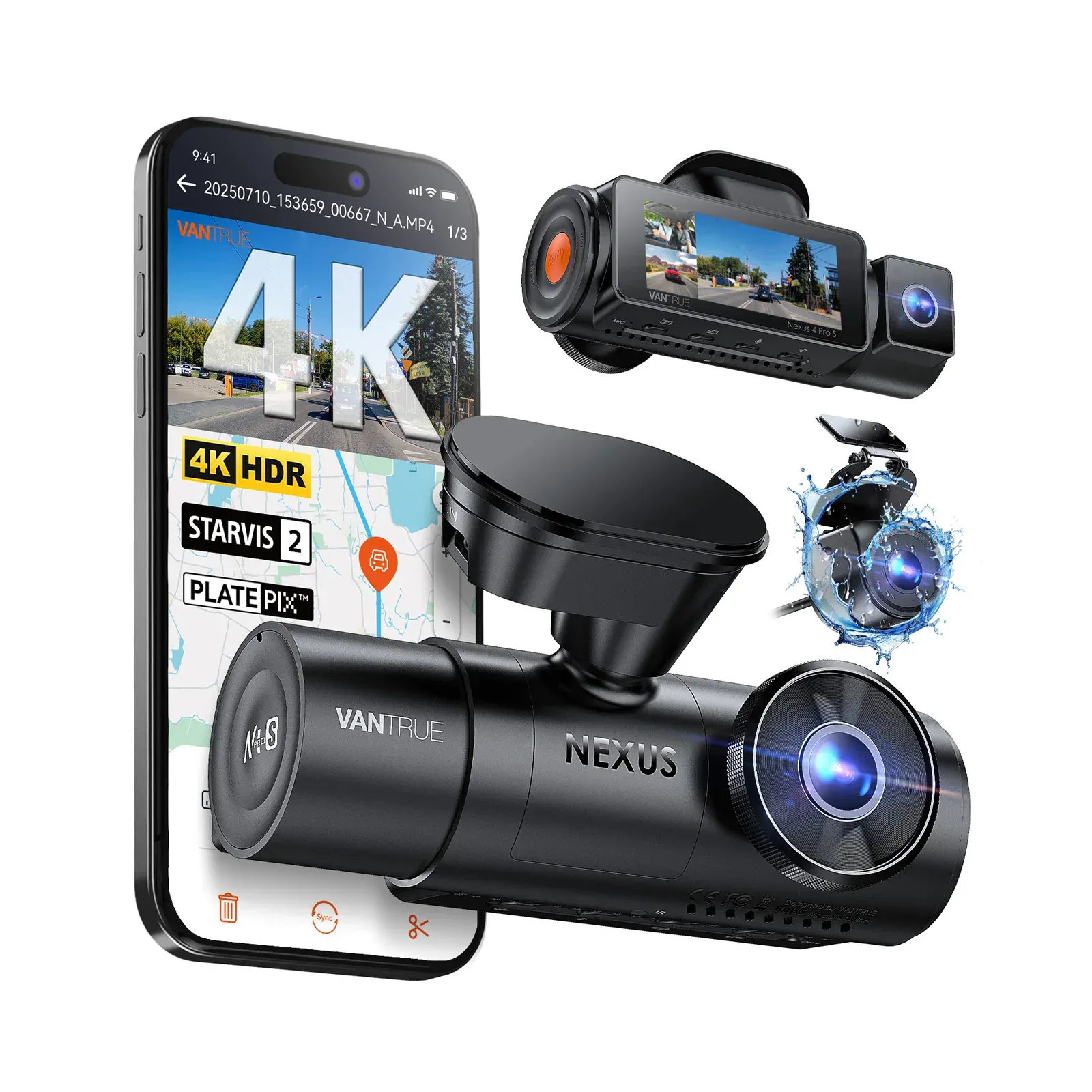
The Nexus 4 Pro S is a three-channel system that brings the brand's most capable sensor package to a front-interior-rear configuration. All three cameras use Sony STARVIS 2 sensors: the IMX678 up front for 4K recording, the IMX675 at the rear for 2.5K output, and the IMX662 in the cabin with four dedicated IR LEDs for total-darkness interior recording. The front camera's 155° field of view and the rear's 160° wide angle give the system meaningful coverage without the fisheye distortion that wider lenses can introduce.
PlatePix™ technology appears here alongside triple HDR processing, which the brand describes as dynamically adjusting exposure across all three channels simultaneously to handle tunnel entries, direct sunlight, and nighttime driving without overexposure or noise artifacts. The rear camera carries an IP67 waterproof rating, which opens up exterior mounting options that an interior-only rear camera cannot match.
Optional LTE live monitoring is available, and the system supports up to 1TB of microSD storage, a practical ceiling for anyone running extended parking mode recording. The super capacitor design (in place of a lithium battery) is worth noting: capacitors handle heat better than batteries, which matters in a device that sits on a windshield in summer. Buyers who want the Nexus 4 Pro S as part of a bundle should note that the standard listing covers the standalone camera only.
Sonnet 1 Pro Max
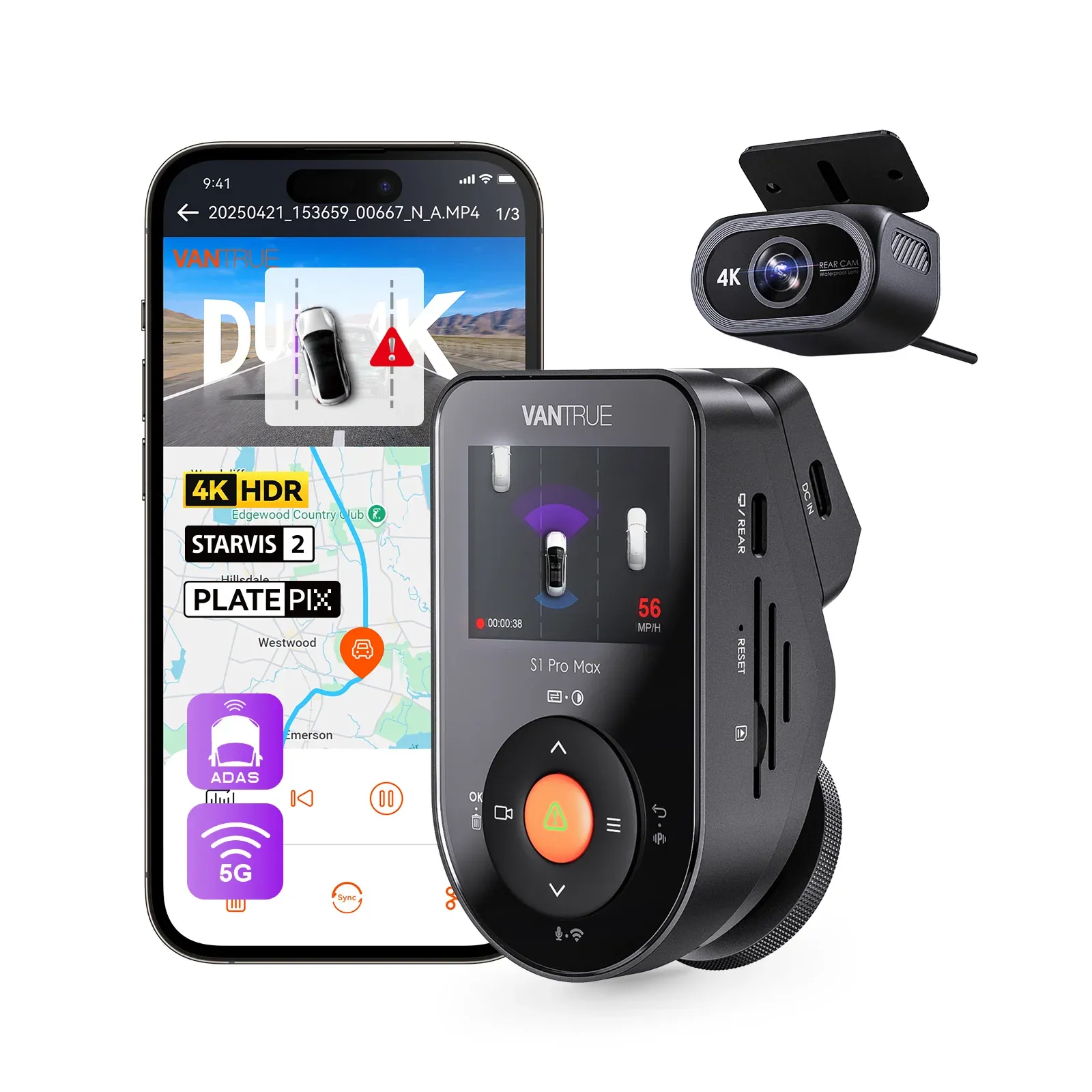
The Sonnet 1 Pro Max is the brand's clearest statement about what a two-channel dash cam can do when the sensor and AI processing budgets are maximized. The top configuration pairs dual Sony STARVIS 2 IMX678 sensors for 4K front and 4K rear recording at 30FPS, with 155° HDR lenses on both ends. A second configuration substitutes an IMX675 sensor at the rear for 2.5K output, and a front-only option is also available for buyers who don't need rear coverage.
What separates this model from a straightforward dual-4K camera is the Vantrue Intelligence suite. The in-cabin AI monitors for driver fatigue and distraction. The rear camera's AI watches blind spots and alerts when a vehicle enters them. The Driver Monitoring System adds collision and lane departure warnings, a start alert, and what Vantrue calls a Virtual Bumper feature. LTE compatibility enables remote monitoring, real-time alerts, and parking location tracking. The 15-second pre-recording buffer and dual-system GPS logger (compatible with both PC and smartphone) complete a package that sits clearly at the premium end of the two-channel category.
The Sonnet 1 Pro Max is priced and spec'd for drivers who want their dash cam to function closer to an active safety system than a passive recorder. Buyers who want solid coverage without the AI features will find the Nexus 4 Pro S or even the Nexus 5 better value for their use case.
Which Vantrue Camera Fits Your Situation
The right Vantrue model depends almost entirely on how many angles you need and how much you want the camera to do beyond recording. The Sonnet 1 Pro Max is the choice for drivers who want the sharpest possible front-and-rear footage with active AI monitoring and LTE connectivity. The Nexus 4 Pro S covers three channels with the same sensor quality at a configuration that suits most non-commercial drivers. The Nexus 5 is the one to reach for when four-channel coverage is the priority, particularly for rideshare or fleet use. The E360 stands apart from all of them as the option for buyers who want 360-degree coverage from a single mounting point, with the optional rear camera available for those who want dedicated exterior coverage as well.
Vetted Verdict
Drivers who have been burned by dash cam footage that was technically present but practically useless (blurry plates, washed-out night shots, missing angles) will find Vantrue's sensor-first approach directly addresses those frustrations. The Sony STARVIS 2 sensors, PlatePix™ processing, and multi-channel configurations are not marketing additions layered onto a commodity product. They reflect deliberate choices about what makes footage actually usable after an incident. The installation complexity and the need for separately purchased hardwire kits for full parking mode functionality are real costs to factor in, and buyers who want a simple plug-and-drive single camera will find simpler options at lower price points. But for the driver who wants clear documentation in all conditions and who values a product with higher quality components, Vantrue is a very solid option.